Every week, knowledge workers across the world write the same email. Subject line: "Recap from [meeting name] — [date]." Body: a semi-accurate summary of what was discussed, one or two action items that may or may not be complete, and a closing line about following up. Then it goes into an inbox where it competes with 200 other emails for the reader's 15 seconds of attention.
The recap email is a workaround. It exists because the tools we use to run meetings don't produce a reliable record of what happened. And like most workarounds, it creates as many problems as it solves.
What's Wrong With Recap Emails
The problems with recap emails are well-known but rarely examined together:
They're slow. The meeting ends at 3 PM. The recap email arrives at 5 PM if you're lucky, the next day if you're not. In the gap, people are making decisions based on their individual memory of what was agreed.
They're selective. The person writing the recap captures what they noticed. They may not have caught everything. Their attention during the meeting was divided between participating and mental note-taking. The recap is filtered through their perspective.
They live in the wrong place. The recap is in email. The work it references happens in Notion, Jira, Slack, or your CRM. Bridging those worlds requires manual effort — reading the email, copying the action items, pasting them into the right tool. Most people don't fully complete this transfer.
They're not searchable in context. Six months later, when you need to know what was decided in the Q3 planning call, you're hunting through email threads rather than searching a structured record.
What AI Summaries Do Instead
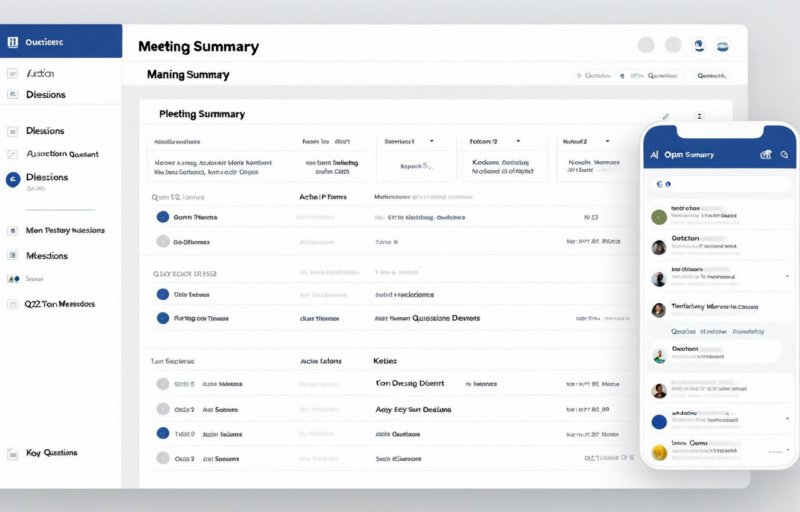
An AI-generated meeting summary from a platform like SmartyMeet arrives in your Notion, Slack, or email within minutes of the meeting ending — not hours. It's structured consistently: key points, decisions made, action items with owners, next steps. It's derived from the full transcript, not from one participant's selective attention. And it links back to the transcript, so any disputed point can be verified in seconds.
The shift this creates isn't just time savings — though that's real. It's a change in the authority of the record. The AI summary is objective. It isn't anyone's interpretation. When a team member asks "but I thought we decided X," the answer isn't "let me find the email I sent" — it's a link to the section of the transcript where the decision was made.
"The summaries are scarily good. I shared one with a board member who wasn't on the call and they said it felt like they were there." — Tobias Werner, CEO, Stackform GmbH
The Formats That Work
Not all meeting summaries need to look the same. The format that works for a daily standup is different from the format that works for a quarterly board review. SmartyMeet supports several summary formats to match different meeting types:
- Executive brief: Three to five bullet points capturing the most important decisions and next steps. Designed for sharing upward or with stakeholders who weren't on the call.
- Structured recap: Decisions, action items (with owners and deadlines), key discussion points, and open questions. The full record for people who need complete context.
- Bullet-only: A clean numbered list of everything notable that happened in the meeting, without structure or categorization. Fast to write, fast to scan.
Teams can configure which format is default for different meeting types — and override it on any individual meeting.
The Integration Problem (And the Solution)
A summary in email is still a summary in email. The reason AI meeting summaries work as a recap email replacement isn't just that they're faster or more accurate — it's that they push to the right destination.
When the summary lands in the Notion project database for the sprint that meeting was about, it becomes part of the project record. When the action items push as tasks to Jira, they're in the system where they'll be tracked against a deadline. When the customer meeting highlights go directly to the HubSpot deal, the CRM stays current without anyone typing.
The 0-to-workflow gap: The single most important measure of a meeting intelligence tool is how close it gets action items to zero manual effort between the end of the meeting and the items being tracked in your workflow tools. If someone still has to copy and paste anything, the tool hasn't fully solved the problem.
The Adoption Curve
Teams that switch from recap emails to AI summaries typically go through a predictable adoption curve. In the first two weeks, there's skepticism. People read the AI summary alongside the email they were going to send, comparing them. They find a few things the summary got wrong or phrased oddly. They correct them.
By week four, they stop sending recap emails entirely. The summary is good enough that the email would just be redundant. By week eight, the question "did someone send the recap?" disappears from their team vocabulary. The summary just happens.
By month three, they start relying on the summary as the source of truth in ways they wouldn't have trusted a human-authored email for. They search it. They reference it in disputes. They share it with new hires as context for ongoing decisions.
The recap email isn't just replaced — it's forgotten.